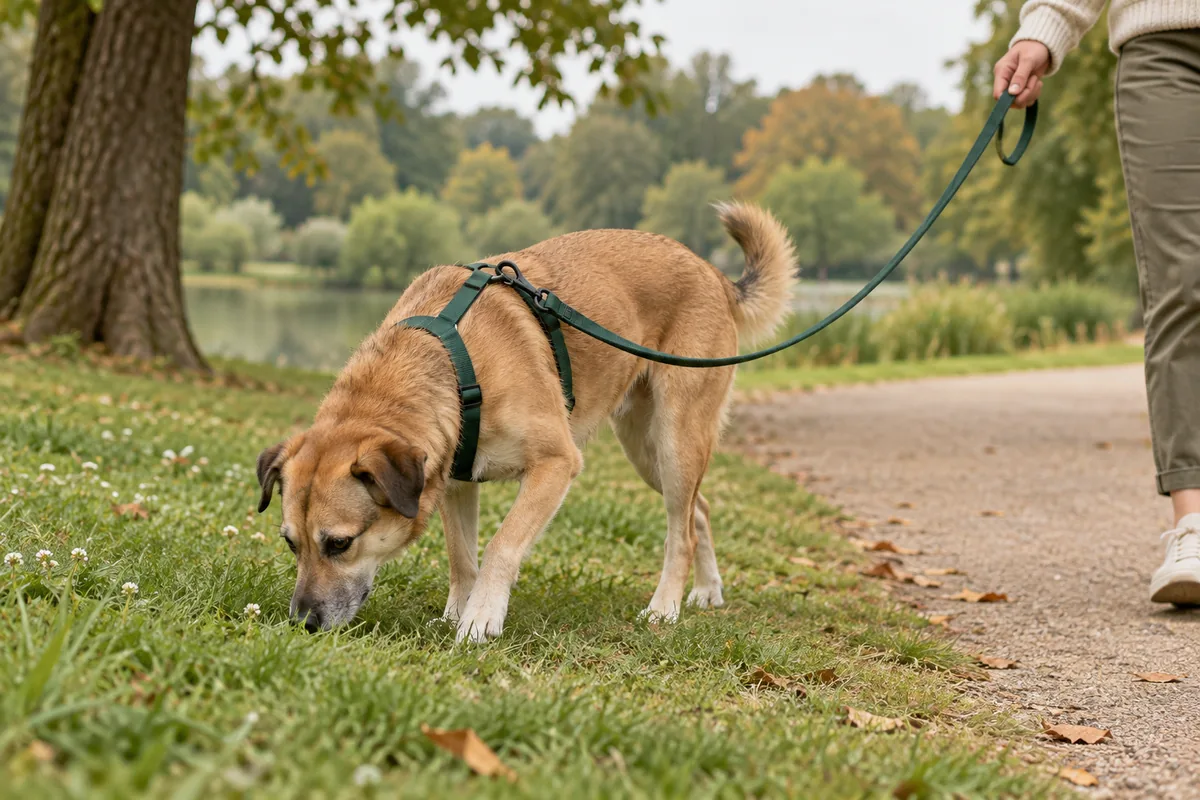
Editorial illustration · Not a customer photograph or product test.
In this field guide
Yes—make room for sniffing where the surroundings are suitable, while keeping enough control to move past traffic, rubbish and other animals. A useful walk can include both time to investigate and sections where you need to keep moving. You do not have to choose one style for the entire route.
The practical difficulty is familiar: you leave with twenty minutes available, but your dog has other plans at the first patch of grass. Rather than treating every stop as a conflict, decide beforehand where you can pause. This guide offers a route-planning approach, not a prescribed exercise schedule or a promise that sniffing will tire every dog out.
01What a sniff walk actually changes
A sniff-focused walk changes your priority from covering a route to giving your dog opportunities to investigate it. You may cover less ground and spend more time in one suitable area. Blue Cross describes this kind of exploration as one way to make on-lead walks more interesting. Its guidance on scent work also treats using the nose as an enrichment activity.
That does not establish a conversion between minutes of sniffing and miles of exercise. Nor does a dog falling asleep afterward prove a particular health benefit. Choose activity around the individual dog, and ask your vet about exercise when age, illness, recovery or an unexplained change in behavior makes the decision uncertain.
02Plan three types of space, not a perfect route
Before leaving, divide your usual route into places where you can explore, places where you need to pass through, and places you will avoid. This is an organizational aid: it helps you make decisions before you are standing at the end of a tight leash.
| Part of the route | Your plan | What to watch |
|---|---|---|
| Wide, quiet verge or permitted park area | Leave room for an unhurried sniffing stop. | Discarded food, waste, plants and approaching people. |
| Crossing, narrow pavement or busy entrance | Move through together; investigate elsewhere. | Traffic, bicycles, doors and other dogs. |
| Private planting, wildlife area or visibly contaminated spot | Choose another place. | Access rules and hazards, even if the scent interests your dog. |
A small loop with suitable stopping places may be easier to manage than a longer route full of obstacles. You can use the same starting point and change your turnaround point. Check local access and leash rules; a quiet-looking field is not automatically open to dogs.
03Give yourself a turnaround point
Suppose you have a short gap before work. Instead of committing to a distant park, choose a nearby area and decide when you need to turn back. Keep a little time in reserve for the return journey. The point is to protect the time you do have, rather than repeatedly rushing your dog because the planned circuit is too long.
On a more flexible day, you can pause longer or visit another suitable spot. Do not judge the two walks solely by distance. Record what was manageable: whether the path was crowded, whether you could hold the leash comfortably, and whether you needed a quieter route. Those observations are more useful for tomorrow's plan than trying to copy another owner's schedule.
04Choose manageable equipment
You do not need to buy a new walking setup just to allow more pauses. Start by checking the equipment you already use: the attachment, buckle, stitching and adjustment points. Use the manufacturer's instructions, and confirm fit on your dog rather than assuming a letter size tells the whole story.
If you are uncertain about fit, take clear photographs from the side, front and above for the seller or an appropriate professional. PawFurvia's harness and collar measuring guide provides a starting point; the measurements on the specific product still matter. Do not substitute a generic chart when that product's dimensions are missing.
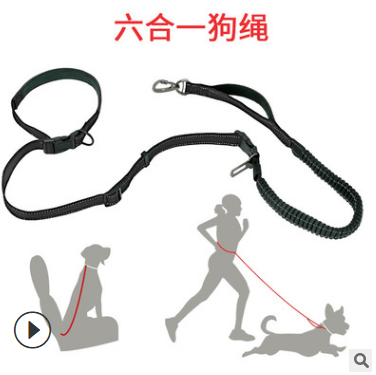
Choose leash length around the space and your ability to manage it. More length is not automatically more suitable. A line stretching across a shared path can obstruct others, while excess line around feet creates handling problems. For equipment comparisons, see the guide to standard leashes, retractable leashes and long lines. Check attachment compatibility before changing your setup.
05Make transitions predictable
Use familiar, reward-based cues to move between investigating and walking on. Practice away from busy crossings; a hazardous location is not the place to introduce a new skill. If you need help teaching a transition, seek a qualified reward-based trainer who can observe your dog and your handling.
It can help the household agree on the same words and expectations. Write down which cue means “we are moving,” where pauses are normally possible, and what situations require a different route. A dog walker or sitter should receive those notes alongside the equipment, rather than having to discover your routine during the first outing.
06Stay interested in what your dog is investigating
Allowing sniffing does not mean looking away. Check the ground before stopping and continue watching the surroundings. Move away from discarded food, broken glass, unknown substances or wildlife. Give other walkers enough room, and respect gardens and areas where dogs are restricted.
If your dog repeatedly grabs things from the ground, or you cannot move on comfortably, discuss that specific problem with a qualified professional. Do not assume a longer line or a different harness will solve it. Likewise, a sudden reluctance to walk deserves attention rather than being dismissed as a preference for sniffing.
07A simple note to keep on your phone
- Where: Name two suitable stopping places and one alternative route.
- When: Set a turnaround time, leaving room to get home.
- Equipment: Check fit and attachments before leaving.
- Transitions: Use the familiar cue everyone in the household knows.
- Afterward: Note one thing to keep and one thing to change.
For example, your note might say: “The side path was quiet, but the entrance was crowded. Next time, pause beyond the gate and turn back before the school pickup.” This is a planning example, not a tested route recommendation.
08Do you need to let your dog sniff every spot?
No. You can allow investigation in suitable places and still move past locations that are unsafe, inaccessible or inconvenient for other people. The goal is a workable routine with room for exploration. You can browse walking leashes if your current equipment does not suit that routine, but start with the route and handling problem before deciding what to buy.
09Sources and further reading
- Blue Cross: Keeping walks on a lead fun
- Blue Cross: Scent work for dogs
- RSPCA Education: Let dogs sniff
Handing this routine to another person? Use the dog-walker handover sheet to share your dog's route, cues, gear fit and emergency plan.