Dog Adventure · Everyday routine
Quick answer: A sustainable before-work walk starts the night before. Prepare fitted gear, choose a short route with an easy extension, and leave enough time for your dog to toilet and explore without making a rushed doorway your daily pattern.
Morning walks can fail for ordinary reasons: the lead is missing, the route takes longer than expected, or the dog wants to investigate a patch of grass just as your first meeting approaches. The answer is a flexible routine, not a promise that every dog needs the same number of minutes. Age, health, weather and your dog's preferences matter more than a universal timer.
1. Make the exit simple the night before
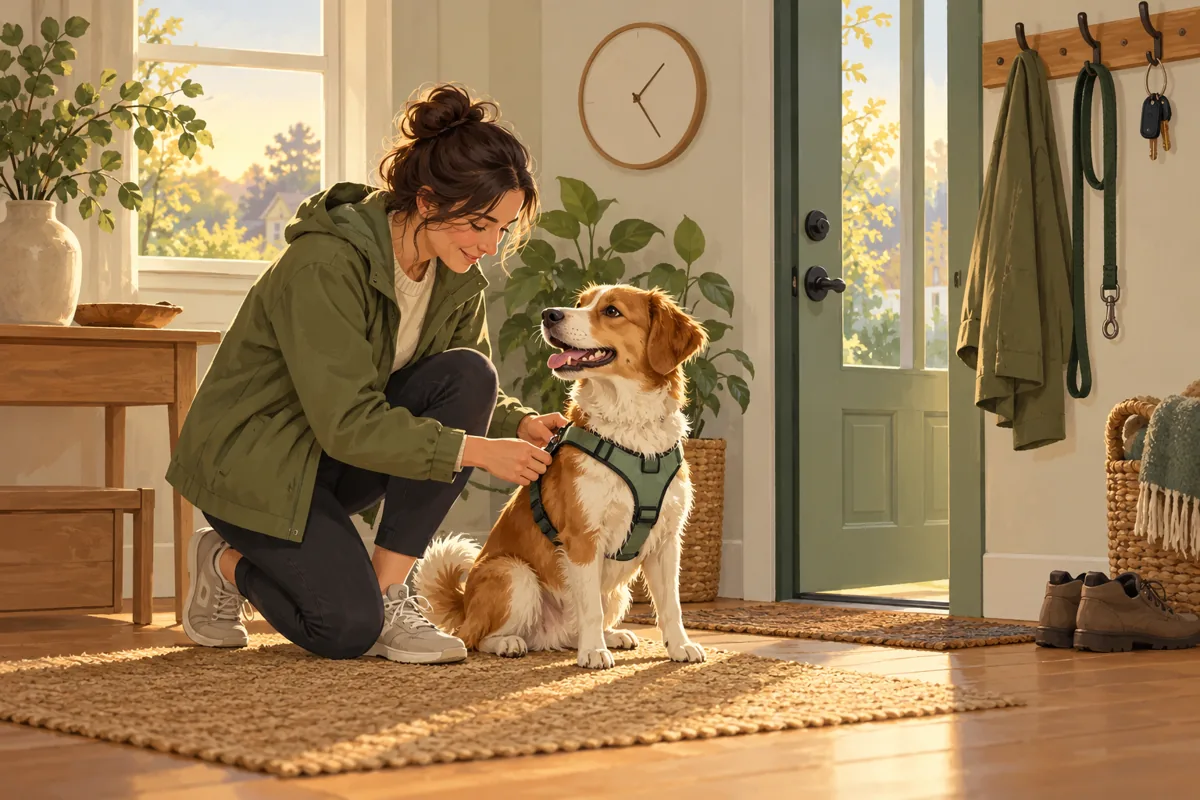
Put the lead, waste bags, keys and a weather-appropriate layer in one place. Check the clip and webbing while there is still light, then check the harness fit again on the dog in the morning. If your dog is growing or has changed weight, consult the product's size chart and our measuring guide instead of trusting the letter size on old gear.
Plan the return as well as the departure. Leave a towel near the door if the route is wet, know where used waste bags can go, and keep fresh water available. A routine that ends in a scramble is hard to sustain, however pleasant the walk itself may be.
2. Design a short loop with one optional extension
Pick a core route that covers essential toileting and a calmer patch where your dog can investigate. Add a second loop only when time and conditions allow. This keeps a busy day from becoming a no-walk day while preserving choice on easier mornings. A dog who prefers a predictable circuit may appreciate the same turn points; another may like variety. Blue Cross advises dog walkers to ask whether an individual dog prefers routine or different routes.
Separate the transit section from the exploration section. Near driveways and crowded pavements, keep a manageable lead and focus on shared space. Once you reach a suitable place, make time for sniffing. Our sniff-walk route plan gives a practical way to do that without insisting on every possible stop.
3. Budget for the moments you cannot schedule exactly
Start with the time you must be back, then work backward: gear and exit, walking, return cleanup and a margin for one delay. Avoid treating the entire available window as walking time. A small buffer makes it easier to respond calmly if your dog needs extra toileting time or you have to take a safer crossing.
| Part of the routine | What to decide |
|---|---|
| Before the door | Where gear lives; how fit is checked; whether the weather changes the route. |
| Core loop | Which crossings and quiet patch can be used even on a busy morning. |
| Optional loop | Where to extend when the dog is comfortable and your schedule allows. |
| Return | Where wet gear goes, water, and any handover to another caregiver. |
When your dog repeatedly seems reluctant, exhausted or distressed, reconsider the routine. Talk to a veterinarian about any health concern rather than assuming more walking is always better. RSPCA walking guidance notes the importance of safe, responsible walking and taking conditions such as heat into account.
4. Illustrative scenario: a meeting moved earlier
Example scenario, not a customer account: A household usually takes a dog along a quiet 25-minute loop before a 9 a.m. meeting. On one day the meeting moves to 8:30. The walker uses the prepared core loop, still pauses at the grassy corner for toileting and a short sniff, then returns to the ready towel and water. They move the longer exploration to another part of the day rather than pulling the dog through the usual full route at speed.
This does not prescribe a walk duration. It shows why a short and long version of the same route can be more workable than an all-or-nothing plan. Puppies, seniors and dogs with medical needs require their own activity advice.
5. Make it repeatable for another caregiver
If someone else handles some mornings, write down the core route, the cue words your dog knows, the gear setup and how to contact you. Our dog-walker handover sheet turns those details into a one-page document. Include the safe alternative when the regular route is blocked or crowded; see the busy-pavement passing plan for narrow shared paths.
Do not leave medication decisions, off-leash permissions or an emergency response to assumption. Review the instructions together before the first solo morning.
6. Check the routine after one week
Ask three questions: Is the dog comfortable on the route? Does the household usually return without rushing? Is there enough flexibility for weather, traffic and changed schedules? If the answer is no, adjust the route or timing rather than simply adding a stricter alarm.
Keep useful notes brief: actual start and return time, where the dog relaxed, and what repeatedly caused delay. A routine you can keep, revise and share is more valuable than a perfect plan that lasts two mornings.
Related reading
This is general pet-care information, not individualized veterinary advice. The schedule example is fictional and is not a customer testimonial or product test. Any editorial image is an illustration.