Dog Adventure · Practical Guide
A good dog-walker handover is short enough to use at the door and specific enough to prevent guesswork. This guide helps you document the gear, route, cues and contact plan that matter to your own dog.
Quick answer: Give your walker one dated page covering fit and equipment, walk boundaries, your dog's normal behavior, emergency contacts and how to report back. Walk together once before the first solo visit.
1. Why a handover matters
Even an experienced walker cannot know whether your dog freezes near bicycles, prefers a quiet lane, or responds to “here” rather than “come.” A written handover turns those details into an agreed routine. Blue Cross advises owners to share a dog's likes, allergies, medical conditions, vet details, emergency contact and cue words with a dog walker. Its guidance also recommends asking how the walker manages group walks and emergencies.
The document is a starting point, not a substitute for a face-to-face introduction. If your dog has medical or behavioral needs, discuss them directly and ask the relevant veterinarian or qualified behavior professional for individual advice.
2. A one-page dog-walker handover template
Keep a copy at home and give the walker a current digital copy. Use the fields below as prompts; share private contact information directly with the walker, not on a public web page.
Ready-to-use version: Fill in and print the dog-walker handover sheet. For phone numbers and health details, print a blank copy and fill those fields offline.
| Field | What to record |
|---|---|
| Dog and date | Name, age, handover date, and when the instructions should be reviewed. |
| Walk plan | Typical duration, preferred route, safe alternatives, weather limits and whether group walks are allowed. |
| Equipment | Harness or collar, adjustment points, leash type, where gear is kept and a photo showing correct fit. |
| Cues and triggers | Words your dog knows, reward type, situations to avoid and what to do when the dog is worried. |
| Health | Relevant conditions, allergies, medications handled by the owner and any veterinarian-set activity limit. |
| Contacts | Your reachable number, alternate contact, regular vet, emergency vet and your agreed decision process. |
| Report back | Pickup and return time, route, toileting, appetite or energy changes, gear issues and any incident. |
Copy a blank handover sheet
Paste this into a private document and fill it in for your own dog. Share contact and access details only with your walker.
DOG-WALKER HANDOVER | Date reviewed: ________
Dog: __________  Owner: __________
Walk duration and usual route: ____________________
Safer alternative / weather limit: _________________
Group walks or off-leash allowed? _________________
Harness or collar; fit and clip check: ______________
Primary leash and backup: _________________________
Known cues and rewards: ___________________________
Triggers and what helps: __________________________
Health or activity limits (discuss privately): ______
Owner / backup contact (share privately): __________
Regular / emergency vet (share privately): _________
If an incident happens, call: ______________________
After-walk update: time, route, toileting, issues _____
Next review date: __________
Take a photo of the correctly fitted gear and walk the route together before the first solo booking.
Keep the wording concrete. “Cross the road when a skateboard approaches” is more useful than “can be nervous.” Update the sheet after a change in health, gear, route or contact details.
3. Show the walker how the gear fits
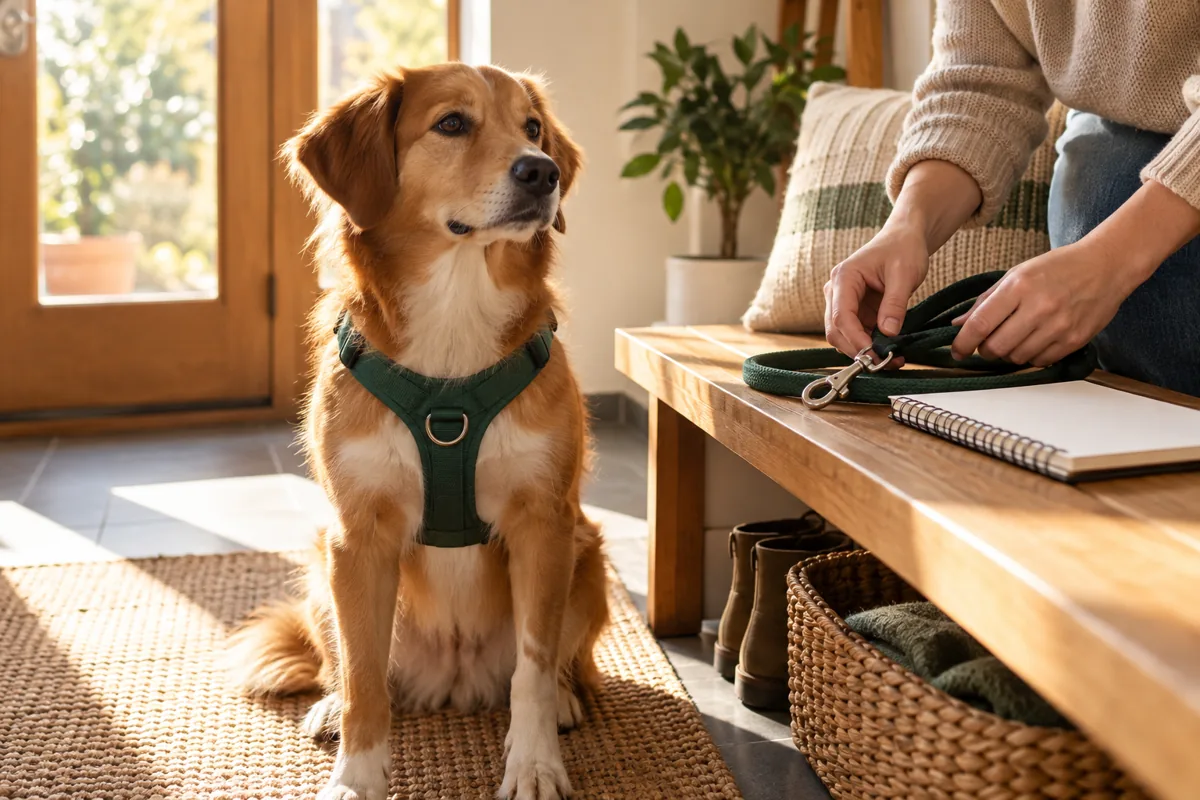
Put the harness on your dog together. Show which strap can loosen, where the leash clips, and how to check that the dog cannot back out. Record the exact setup you use rather than assuming that a product fits every dog in the same way. If you are buying a new harness, start with our dog harness measuring guide and confirm the chosen product's size chart before ordering.
Agree on one primary leash and one backup. Our leash selection guide explains the tradeoffs; the retractable versus standard leash comparison is useful if the walker and owner normally use different equipment. A regular leash is often easier to manage in a busy shared space, but match the choice to your dog and local rules.
4. Agree on route, pace and cues
Walk the route once together. Point out intersections, entrances, off-limit paths and places where your dog usually pauses. For a crowded sidewalk, use our busy-pavement passing plan to agree on a wider alternative. Specify whether the walker may change the route or allow off-leash time; do not leave either decision implicit. Ask how many other dogs will be present and what happens if one dog becomes distressed.
Some dogs enjoy a calm sniffing stretch; others need a more predictable route. Our sniff-walk route plan shows how to leave time for exploring while keeping a clear route and safety boundaries. Tell the walker your dog's actual preferences rather than treating that plan as a universal schedule.
5. Set an emergency plan before it is needed
Write down who the walker calls first and second, where the regular and after-hours veterinary clinics are, and how the walker can transport the dog if needed. Tell the walker what identifying information is available if the dog gets lost. Blue Cross specifically lists veterinary details, medical conditions, an emergency contact and microchip information among the details to provide. Its first-aid guidance recommends urgent veterinary help for signs such as breathing difficulty, pain or inability to walk normally.
Do not ask a walker to diagnose or medicate without a veterinarian's instructions. Agree that they will secure the dog and contact veterinary professionals promptly when there is an injury, escape, collapse or other concerning change. Keep the private numbers in the handover sheet, not in a collar tag photo posted online.
6. Rehearse, then revise after the first walk
- Introduce the dog and walker together. Watch how the dog responds to handling and gear.
- Practice pickup and return. Confirm door, key, water and where wet equipment goes.
- Take a short trial route. Demonstrate cues and your response to common triggers.
- Agree on updates. A brief message after each walk can note timing and any change worth watching.
- Review the sheet. Revise what was unclear rather than adding pages of generic rules.
7. Questions to ask before booking
Should I write a different sheet for each walker?
Use the same core dog profile, then add practical access and scheduling details for that walker. Remove access information when a booking ends.
Should my walker use my dog's usual harness?
Consistency helps the walker understand the fit and control setup. Demonstrate the actual harness and check it before the first solo walk; replace worn equipment when needed.
How often should I update the plan?
Review it whenever the dog's health, behavior, equipment, route or emergency contacts change. A date on the sheet makes an outdated copy easier to spot.
Takeaway: One usable page and one practice walk are better than an impressive document the walker cannot follow at the doorstep.
Related reading
Illustration is a generated editorial scene, not a photograph of a customer, walker or PawFurvia product test. This article is general care information and does not replace veterinary advice.