Last updated: October 29, 2026
Short answer: For everyday walks near traffic, doors, and other dogs, a standard fixed-length leash (about 4–6 ft of usable control) gives the most predictable handling. A non-retractable long line is the clearer way to offer freedom in open spaces. Retractable leashes can suit some calm, well-trained dogs in open areas, but they carry specific safety and training tradeoffs you should weigh honestly.
For material and length shopping details, pair this article with how to choose the right dog leash. This page stays on retractable vs fixed vs long line tradeoffs.
Why the debate keeps returning
Owners repeatedly report the same failure modes with retractable leads: thin cord that burns or cuts when it wraps a hand or leg; locks that fail under a hard pull; a dropped plastic handle that clatters and scares a dog into running; and a dog that is simply too far away to control near a road. Those patterns show up across public discussions—treat them as risk patterns to manage, not as proof that every retractable is identical.
Side-by-side comparison
| Leash type | Good for | Main tradeoffs |
|---|---|---|
| Standard fixed 4–6 ft | City walks, training, vet visits, crowds | Less long-distance sniffing unless you pause on purpose |
| Fixed long line (often 15–30 ft) | Recall practice, open parks/beaches where allowed | Tangles; needs gloves and harness attachment; active management of slack |
| Retractable | Some calm dogs in open, low-risk spaces | Cord injuries, lock issues, dropped handles, variable length that complicates training |
| Hands-free waist leash | Running/stroller walks with steady dogs | Surges transfer to your hips; not for hard lungers yet |
When fixed length wins (most urban days)
- Sidewalks, parking lots, apartment lobbies, and cafe patios.
- Any dog still learning loose-leash walking.
- Strong pullers and reactive dogs that need predictable distance.
- Two-dog walks where variable length multiplies chaos (walking two dogs).
- Night walks where you must keep the dog inside the pool of streetlight.
Fixed leashes make emergency stops simpler: you already know the maximum distance. Soft product examples to evaluate against your needs:
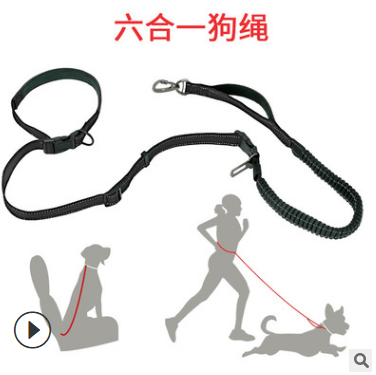
- 6-in-1 multi-function leash — adjustable polyester, about 156–252 cm overall per PDP, secondary handle for closer control; seat-buckle section is travel convenience, not a crash-tested restraint.
- ~10 ft (3 m) multi-way round rope leash — use full length only where space and rules allow; gather slack on narrow paths.
Browse: all dog leashes.
Retractable tradeoffs (honest list)
- Variable length makes timing harder in training—dogs often learn that pulling creates more distance.
- Thin cord or tape can injure skin if grabbed or wrapped.
- Lock buttons can fail or be slow under panic.
- Dropped handles chase some dogs into traffic.
- False sense of freedom near roads: “locked” at 10–12 ft is still too far for many urban surprises.
If you still use a retractable
- Lock it short near roads, doors, parking lots, and other dogs.
- Never grab the moving cord; never let it wrap fingers or legs.
- Clip to a fitted harness, not a collar, so sudden stops do not jerk the neck (harness vs collar).
- Practice calm recovery if a noisy object follows the dog—so a dropped handle is less catastrophic.
- Retire damaged cord immediately; do not knot-repair load-bearing line.
Long lines as the safer “freedom” tool
A fixed long line gives distance you choose and can see. Use it in open areas away from roads, clip to a harness, wear gloves, and manage loops so neither of you steps into coils. Long lines are training tools, not casual sidewalk gear. They pair better with recall practice than with distracted phone scrolling.
More on length tradeoffs: how long should a dog leash be. Sniff-walk structure: should you let your dog sniff on walks.
Hands-free note (keep short)
Hands-free waist leashes are fixed or semi-fixed systems—not retractables—but they share one risk: a hard lunge moves your whole body. Use them after manners exist. Category: hands-free dog leashes; overview: is hands-free right for you.
Training angle without a full no-pull essay
Constant light tension teaches dogs that leaning forward pays. Fixed leashes make slack/tight clearer for both of you. If pulling is the main problem, combine a fitted harness with training guidance in what no-pull harnesses actually help with—do not expect a retractable lock button to replace that work.
Decision flow
- Near cars, bikes, crowds? → Fixed 4–6 ft control.
- Open field + solid recall practice? → Fixed long line on a harness.
- Calm adult, open space, you accept retractable risks? → Optional, locked short near any hazard.
- Running with a steady dog? → Hands-free waist system, not a retractable cord.
- Two dogs? → Fixed lengths first; see two-dog guide before couplers.
Shipping and returns
Ordering fixed leashes from PawFurvia: US delivery typically 7–12 business days from dispatch; free shipping often over $59 (shipping policy). Returns generally within 30 days of delivery (refund policy). Questions: [email protected].
Scenario walkthroughs
Apartment elevator + lobby: Fixed short leash. Retractable locks still leave extra cord that other people can step on.
Suburban sidewalk with driveways: Fixed 4–6 ft. Cars reverse suddenly; you need the dog inside your reaction bubble.
Fenced empty field for recall games: Fixed long line on a harness. Mark successes; gather line between reps so nobody trips.
Busy farmers market: Fixed short leash only. Crowds and food drops are poor retractable environments.
Quiet beach where leashes are required: Check the posted length rule. If six feet is the law, a 16-foot retractable—even locked—teaches the wrong habit the moment you forget the button.
Kids and guests handling the dog
Retractable mechanisms are easy to misuse. If children or infrequent dog-sitters walk your dog, default to a simple fixed leash with an obvious handle. Fewer buttons mean fewer surprises. Explain the two-finger harness check and where waste bags live in the walking bag before handing over the lead.
Maintenance for whichever leash you choose
- Inspect stitching and clip gates weekly.
- Rinse salt and mud; let webbing dry fully.
- Replace frayed fixed leashes—do not sew load paths with household thread.
- For retractables, follow the brand’s cord-replacement guidance; many household “fixes” are unsafe.
A well-maintained fixed leash plus a fitted harness covers most real weeks. Add specialized tools only when your routes and training plans need them.
FAQ
Are retractable leashes bad for training?
They often keep changing length and can reward pulling for more distance, which works against loose-leash skills. Fixed lengths make feedback clearer.
What is safer than a retractable for giving freedom?
A fixed-length long line clipped to a harness in open areas away from traffic.
Is a hands-free leash safe?
For dogs that walk or jog steadily, it can be. For hard lungers, start with a handheld fixed leash until training improves.
Should a leash clip to a collar or a harness?
For long lines, retractables, and dogs that pull, a harness is the better attachment point. Keep a collar for ID tags.
How long should a standard city leash be?
Most handlers do well around 4–6 ft of usable control. Confirm local rules on trails—many require short fixed leashes.