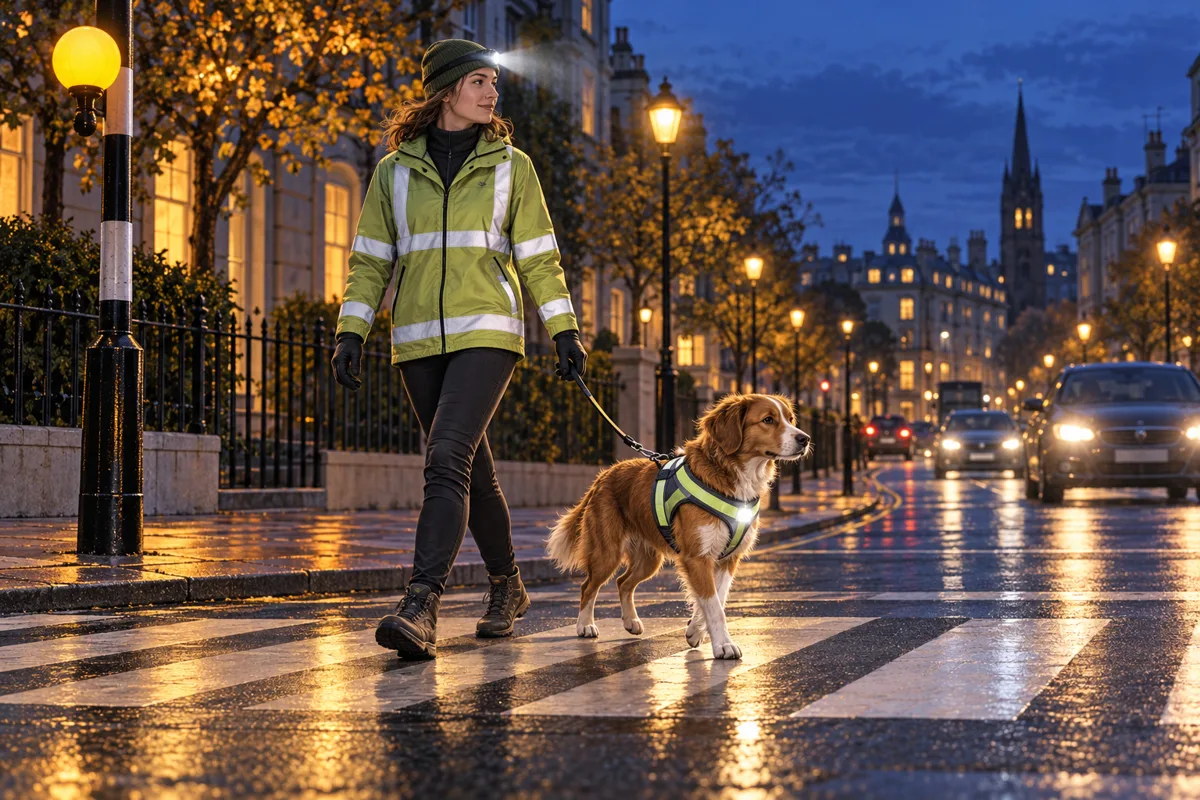
Quick answer: For a low-light dog walk, choose a familiar, well-lit route and make both the walker and dog easier to see. Reflective material helps when a light shines on it; a lamp helps you see the ground and makes you more noticeable. Neither replaces a lead, route judgment or attention at crossings.
1. Choose the route before choosing more gear
Pick a route you already know, with lighting, predictable crossings and a way to turn back if conditions change. Look for broken pavement, uneven steps, narrow verges and places where cyclists or cars may emerge. A short loop near home is more useful than a long route you cannot assess. If an unfamiliar path looks dark or isolated, save it for daylight and use our city route-planning checklist for the safer alternative.
Check the weather and temperature too. Darkness can coincide with rain, wind or cold, but an evening walk does not automatically require dog clothing. If your dog seems uncomfortable in the conditions, turn home and ask your vet about individual needs.
2. What reflective and light-up gear can—and cannot—do
| Item | Useful role | Limitation to remember |
|---|---|---|
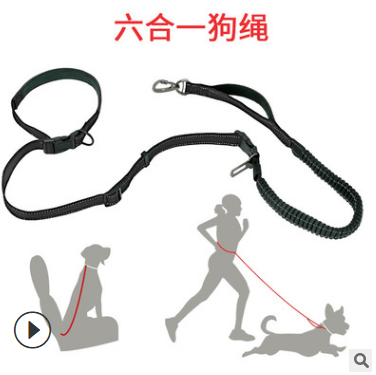
| Reflective lead, collar or harness detail | Returns light from a vehicle or torch toward its source | It needs an external light and may be hidden by fur, clothing or angle |
| LED or other active light | Can make the dog or walker easier to locate in low light | Battery failure, poor placement or glare can reduce usefulness |
| Headlamp or torch | Shows the walking surface and helps the handler keep hands free | Do not shine it into drivers', cyclists' or other dogs' eyes |
| Bright or reflective clothing for the walker | Makes the person at the other end of the lead more visible | It does not establish that a driver has seen you |
The RSPCA advises keeping dogs and walkers visible in the dark; Blue Cross suggests reflective or flashing gear, a torch or headlamp, and a phone. These are sensible layers, not a promise of safety.
3. Test fit, placement and batteries at home
Put all walking gear on in a lit room. Check that a collar light does not dangle where it can catch a strap, that a reflective panel is visible from more than one direction, and that any garment leaves the shoulders and legs free. Run a normal movement check. A product that twists, rubs or slips during a brief indoor walk needs adjustment before you rely on it outside. Our harness measuring guide explains why chest measurements and a physical fit check matter more than breed labels.
Switch lights on before you step out; look at the dog from the front, side and rear. If you use rechargeable accessories, check the charge rather than assuming the previous walk left enough power. Carrying a phone is helpful, but keep attention on the route.
4. Slow down at crossings and shared paths
Shorten your handling distance before a road or narrow crossing so the lead does not stretch across another person's route. Pause where you can see in both directions, then cross when safe. Do not assume a motorist or cyclist has noticed a light or reflective strip. Blue Cross's road-safety guidance recommends keeping dogs on a lead near roads and considering reflective walking equipment after dark. Be prepared to turn around if traffic or visibility makes the planned crossing unsuitable.
In an open park, lighting can create bright islands and dark gaps. Stay close enough to see what your dog is doing and check local lead rules. If your dog is distracted by wildlife or other dogs, choose a quieter route or a different walking time rather than relying on visibility equipment to solve a handling problem.
Example scenario: one bright collar, a dark handler
This is a fictional planning example, not a PawFurvia customer account or product test. A walker puts an LED collar on a dog but wears a black coat and takes an unlit route with a narrow crossing. The collar helps locate the dog but does not reveal a pothole or make the walker easy to see. Next time the walker chooses a lit loop, wears reflective outerwear, brings a headlamp and checks the crossing in daylight first. The lesson is to plan the whole walking pair and route, not one accessory.
5. A 30-second check at the door
- Is the route familiar, lit and appropriate for today's weather?
- Are the lead clip, harness or collar secure and comfortable?
- Can you see the dog and can others see both of you from several directions?
- Are lights powered, and do you have a phone and a way to turn back?
- Have you left enough time for the return leg? Our short-route routine guide shows how to build a realistic return buffer.
If any answer is no, shorten or move the walk. Indoor play or scent activities can supplement a brief outdoor trip when conditions are poor.
Sources and scope
- RSPCA: walking dogs safely and responsibly
- Blue Cross: dogs in winter and walking in the dark
- Blue Cross: road-safety code
General planning advice only. Follow local traffic and lead rules, and get veterinary advice for your dog's individual health or comfort needs.