
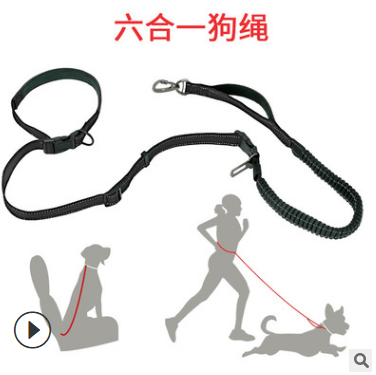
A multi function dog leash shows up in shopping results with diagrams that look like climbing knots. People buy one hoping to stop carrying three leads — then use only the default clip forever. Fair. The diagrams are rarely written like real mornings: coffee, dog spinning, bus to catch.
This guide maps common scenarios to setups: short traffic length, everyday walk length, hands-free waist, dual-clip redirect, and car-adjacent transitions. It points to a 6-in-1 multi-function leash, a 3 m multi-way rope, and a dedicated hands-free waist leash when that job dominates your week. No claim that one product replaces judgment on crowded shared paths — see space and passing.
What “multi-function” usually includes
Different brands count to six differently. Typical building blocks:
- Two clips (or a clip plus a loop) so you can make a shorter looped length
- A sliding ring or ring cluster for adjusting usable length
- A padded handle section
- A waist belt or the ability to connect around your waist
- Sometimes a seat-belt style buckle for car use (treat car use carefully — not all walking gear is a crash system)
You do not need to memorize every marketed configuration. Learn four or five you will actually use, practice them once in the living room, then stop thinking about it.
Scenario → setup map
| Situation | Aim | Setup idea |
|---|---|---|
| Sidewalk near traffic, parking lots | Minimal slack | Short loop / traffic length |
| Neighborhood walk, light sniffing | Standard control | Full everyday length |
| Easy jog / hands busy with stroller on calm paths | Hands free | Waist connection (practiced) |
| Strong forger in training | Redirect | Dual clip to front + back harness rings if your leash supports it |
| Quiet trail sniff break where legal | Slightly more freedom | Lengthen multi-way rope carefully |
| Crowded bridge / bikes | Instant shorten | Traffic length + body block |
Always check local leash laws. Longer is not legal everywhere — ASPCA’s note on obeying local laws is a reminder that public rules sit above gear preference.
Traffic length: the one that saves shoulders
Short usable length keeps the dog in your decision radius when cars, carts, and doors appear. Practice the fold/clip that your leash uses until you can do it without looking. If your multi-function leash fights you here, a dedicated short frog-clip leash in the car is a fine backup for pure close-control moments.
Everyday walk length
This is the default most people want: enough room to walk without crow-hopping, not so much that the dog can hit the curb into the bike lane. If you are still choosing leash philosophy broadly, how to choose the right dog leash and how long a leash should be pair well with this article’s configuration focus. For heat, footing, and handler safety while you walk, see the AVMA walking-your-pet page and VCA dog-walking safety tips.
Hands-free: useful, not automatic
Waist attachment helps on easy paths when the dog already understands loose-leash basics. It is a poor first tool for a reactive lunger on a busy street. Read is hands-free right for you and the running waist-leash starter plan before you belt in on a Saturday farmers-market sidewalk.
If most of your week is jogging, a dedicated hands-free running waist leash may beat forcing every feature into one chameleon lead. Multi-function shines when your week mixes errands, walks, and the occasional easy jog — not when one sport dominates.
Dual-clip / redirect setups
Some multi-function leads can clip to both front and back harness rings. That can stabilize strong dogs while you teach manners. It can also tangle if you are sloppy. Practice in a quiet lot. Pair with a harness that actually has both rings — many tactical / no-pull harnesses do. Remember: redirect physics ≠ finished training (no-pull honesty).
Multi-way rope on trail and city edges
A 3 m multi-way rope is less about six clever diagrams and more about durable line you can shorten for passes and ease out when the path opens — within the law. On technical trail or heavy bike traffic, default short. Details on trail law vs practical length live in hiking leash length and trail rules. Retractables remain a weak match for most of those jobs (retractable vs standard).
Car buckle features — keep claims soft
Some multi-function leashes include a seat-belt tongue. That can help keep a dog from roaming the cabin on calm rides when clipped to a harness. It is not automatically a crash-tested restraint system. For car strategy, pair with purpose-built tethers and covers as discussed in car seat-cover and seat-belt guidance. Do not treat a walking leash as proof of crash performance.
Living-room practice (ten minutes)
- Lay the leash flat. Identify clips, rings, and waist path.
- Make traffic length. Undo it. Repeat until boring.
- Make waist setup without the dog. Then with a calm dog.
- Dual-clip if you will use it — watch for twist.
- Stuff a treat in your waist pack and do one pretend “shorten for a bike” drill in the hallway.
Muscle memory beats PDF manuals at the curb.
Mistakes that make multi-function leashes feel pointless
- Never practicing short length, then panicking in traffic
- Hands-free with a dog who still body-slams squirrels
- Leaving excess loops dangling to snag brush
- Using max length on a shared path “because we paid for it”
- Skipping hardware checks — worn stitching on a clever leash is still worn stitching
A week in setups (example only)
Monday commute walk: traffic length near the garage, everyday length on quiet blocks, traffic again at the arterial.
Wednesday easy jog: waist setup on a known loop; handheld backup in the pocket or pack for the street crossing home.
Saturday trail: multi-way rope short for the first crowded half-mile, slightly longer only where legal and empty, short again at the viewpoint.
Your week will differ. The point is intentional switching — not one lazy default that fails in every edge case.
Teaching household members the same three setups
Partners and kids should not invent new knots. Print a photo of (1) traffic, (2) everyday, (3) waist if you use it. Tape it inside the coat closet. Consistency keeps the dog from getting weird slack one day and surprise short length the next without cueing.
Hardware care
Rinse mud out of sliding rings. Check stitching where clips join webbing. Replace a frayed multi-function leash sooner than a simple lead — more moving parts, more places to wear. Store untwisted.
When to stop using hands-free immediately
- Dog lunges toward aggression or intense fear
- Ice underfoot for you
- Night walk on an unlit road with fast cars
- Any moment you need both hands for the dog and you have already given both hands to the belt
Unclip to handheld. Ego has no place in leash physics.
Pairing with harness choice
A multi-function leash assumes a solid harness ring (or rings). Fashion collars alone are a poor match for dual-clip experiments. Fit the harness first (measuring guide), then layer leash skill.
Why people abandon multi-function leashes (and how not to)
The pattern is predictable: buy because of the diagram, struggle once at a busy corner, toss the leash in a bin, go back to a plain six-foot lead. The fix is not a stern lecture about reading manuals. It is picking two setups, practicing them until they are boring, and only then adding a third.
If the hardware is genuinely awkward in your hands — stiff webbing, tiny rings, clips that need three hands — it is OK to choose a simpler multi-way rope for shorten/lengthen and keep a separate short leash for traffic. Multi-function is a category, not a moral requirement.
Matching leash length to energy, not ambition
A bored adolescent on max length in a crowded plaza is not “enriched.” They are rehearsing chaos. Shorten when arousal climbs; lengthen slightly when the dog softens and the space is empty and legal. The leash becomes a volume knob for freedom, not a trophy for how much rope you own.
Working with a waist pack at the same time
Many multi-function users also wear a pack. Put the pack on first, then the waist leash, so buckles do not fight. Keep waste bags in the same pocket every time so you are not digging while the dog hits the end of the line. A tactical walking waist pack earns its keep when treats and bags land where your hand expects.
Rain, mud, and frozen sliders
Mud in a sliding adjuster turns a clever leash into a fixed length until you rinse it. After muddy weekends, soak and rinse rings. In freezing weather, wet webbing stiffens — practice short length before you need gloves-and-panic dexterity. Store overnight indoors so you are not wrestling a frozen knot at dawn.
Apartment elevators and hallways
Elevators are pure traffic-length territory. Make the short configuration before you leave the apartment door if your dog is strong. Hallways with other dogs deserve the same. Everyday length can wait for the sidewalk.
Cafés and patio sits
If you stop for coffee, gather slack so the dog cannot greet every passerby at full extension. Tuck loops so chairs do not eat them. Some multi-function leads can loop around a table leg — only if you stay attentive; unattended tethered dogs are an escape and tip-over risk.
Travel kit: one multi-function vs specialized set
Flying or road-tripping with limited luggage? One multi-function leash plus a harness can cover a lot. Stay-at-home training weeks might favor specialized tools. There is no prize for owning the fewest leads — only for using what you carry well.
Teaching the dog that length changes are normal
Some dogs freeze or explode when the leash suddenly shortens. Pair shortening with a cheerful treat a few times in the yard: shorten → treat → walk on. Length changes should predict good outcomes, not only “something scary is coming.”
Inspect before it fails mid-week
Once a month:
- Clip gates spring closed firmly
- Stitching at clip tabs shows no unraveling
- Waist buckle teeth are not cracked
- Reflective stitches (if any) still visible for night walks — and remember reflective trim is not a force field (dark-walk limits if you night-walk often)
Replace on wear, not on vibes.
Putting it together with harness rings
Know which ring you are clipping to before you leave. Front ring for redirect sessions, back ring for steady trail tow, dual when you have practiced. Announce it to yourself: “back ring, everyday length.” Tiny verbal habits reduce mid-walk fumbling.
Soft product note
Build a small system, not a museum:
- 6-in-1 multi-function leash for mixed city days when you want traffic length and flexibility in one tool
- 3 m multi-way rope when you want straightforward shorten/lengthen on walks and easy trails
- Dedicated hands-free waist leash if running is the main job
- Short frog-clip for doorways and elevators if you like a dedicated close-control piece
Designed for Pets. Made for the Journey. — the journey includes the boring hallway practice that makes the clever clip useful.
FAQ
What is a multi function dog leash?
A leash designed to change usable length or wearing style — short traffic loops, standard walks, waist/hands-free, sometimes dual-clip or car buckle — using extra clips, rings, or belts. Exact configurations vary by model.
How do I choose a setup for city traffic?
Use the shortest controlled length you can manage smoothly. Practice that configuration at home. Keep the dog out of the bike lane and door-swing zones.
Can one leash replace a hands-free running leash?
Sometimes for light jogging if the waist setup is comfortable and secure. Dedicated running waist leashes often feel better if you run several days a week. Match the tool to the dominant job.
Is dual-clip better for pullers?
It can help manage strong dogs while you train, especially with a front-and-back harness ring pair. It does not finish training by itself.
Are multi-function leashes OK on shared paths with bikes?
Yes if you keep length short when traffic approaches and you can gather slack instantly. Long recreational lengths on crowded paths cause problems regardless of brand. See our shared paths guide.
Do I need to learn all six configurations?
No. Learn the few that match your week. Ignore the rest until you need them.